
Over the centuries, The Banyan tree has taken on significance as a symbol of fertility, life and resurrection – a fitting symbol for ‘VoicesUnderTheBanyanTree’. This storytelling initiative reflects the heart of SEWA-AIFW’S mission: to serve, support and enhance South Asian family wellness. Voices Under the Banyan Tree shares the journeys of community members who have wandered far from their ancestral homes, traversing new frontiers and setting down roots and networks in the US. Through their stories of resilience, achievement and hope, we honor them, and celebrate the vibrant tapestry of the South Asian diaspora.
In the very early days of SEWA-AIFW’s founding in 2004, a group of volunteers felt the pressing need to protect women in the community, and took the initiative to implement the Gender Based Violence program. Twenty plus years later, the program is a core part of SEWA’s services, and many of the offerings that came after: driver’s permit tests on site; meal delivery assistance; and transportation, evolved from this essential work.
Today’s story highlights SEWA’s positive contributions to these families.
SEWA-AIFW’s Gender Based Violence Program
Anjuli Cameron, CEO of SEWA-AIFW, and Raj Chaudhary, the founder of the organization, provide important context for understanding how and why domestic violence manifests within the South Asian community, why cultural context matters when addressing and responding to it, and the critical role SEWA-AIFW’s Gender Based Violence Program plays in this work.
Anjuli also discusses how the Gender Violence Program has informed and shaped SEWA-AIFW’s subsequent program offerings.
Anjuli Cameron – CEO SEWA-AIFW
Anjuli Cameron, CEO of SEWA-AIFW says that of all the SEWA family oriented offerings, the Gender Based Violence program “is life and death” to those who reach out for help.
A small percentage of South Asian women in Minnesota call law enforcement, as immigration concerns, police corruption back home and general trust issues are significant barriers.
”Often times it’s women with children who are experiencing violence. And if we don’t provide support they have nowhere else to turn, and the desperation of that situation, it’s a really scary thought. For the team that works on gender based violence, and for those of us leading the organization, we know how important this is because there is no other option There are no other organizations that can serve our community like we do”. Anjuli Cameron
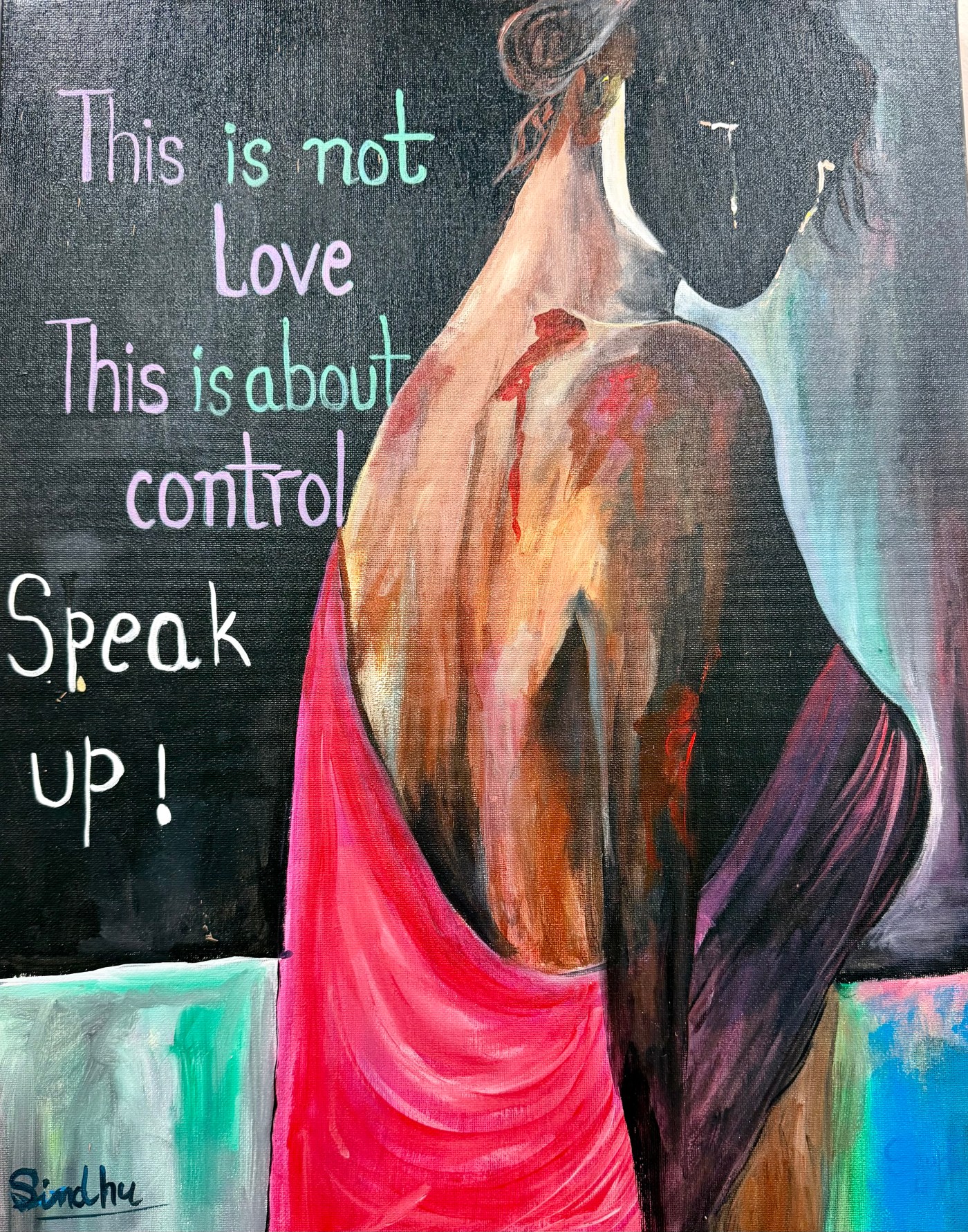
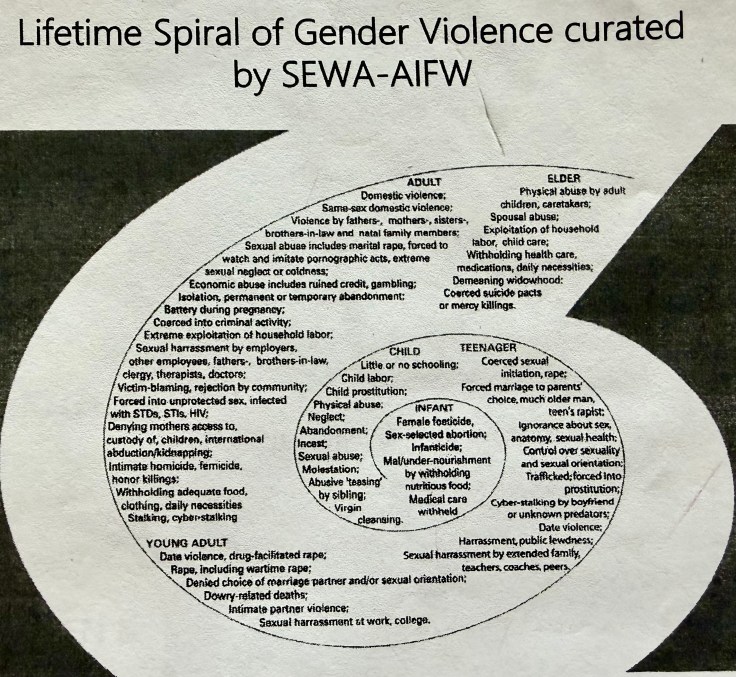
In dealing with gender based violence, there is a real challenge around culture and community, and SEWA’s program is critical for the cultural context it provides. Violence looks different than in a typical American household. It’s not always about causing harm, but centers on the cycle of power and control which plays out differently in the South Asian community: at the intersection of Immigration and Family Law.
Common situations include spousal dependent visas, that make leaving an abusive marriage particularly difficult; extended family dynamics involving parents and in-laws, that force women to remain in households where elder abuse occurs; financial control, including withholding money needed for children’s basic needs and household expenses; and restricting women’s access to food, movement and other nourishment. These situations are entirely foreign concepts to mainstream agencies, hence SEWA partners with the ‘Department of Public Safety’ to provide culturally informed training to agencies state wide.
Anjuli is one of the instructors at their ‘Minnesota Victim Assistance Academy’. She serves on the annual training panel for domestic violence advocates, who are new to the field, or seeking continuing education on the nuances of supporting South Asian women. She provides specialized coaching that addresses the cultural context, so that non-community partners understand how to offer support, and refer cases to SEWA. For those that SEWA helps, many difficult issues don’t need to be explained, as the communication takes place within a ‘shared cultural context’.
SEWA supports women with temporary housing, since shelters have not been a good fit for the community: Many domestic violence victims opt to sleep in their own beds and endure violence vs move to one. Emergency rental assistance and appropriate transitional housing provide stability, and mitigate upheaval in their day to day lives: proximity to their children’s schools, job assistance, and culturally appropriate medical services.
Sewa tries to celebrate and separate the wonderful things of the South Asian culture, from the things that are continuing to do harm and perpetuate the cycle of gender based violence. Perceptions that only uneducated women experience violence, allow men to get away with actions that are inherently culture based, and feed the cycle of power and dominance.
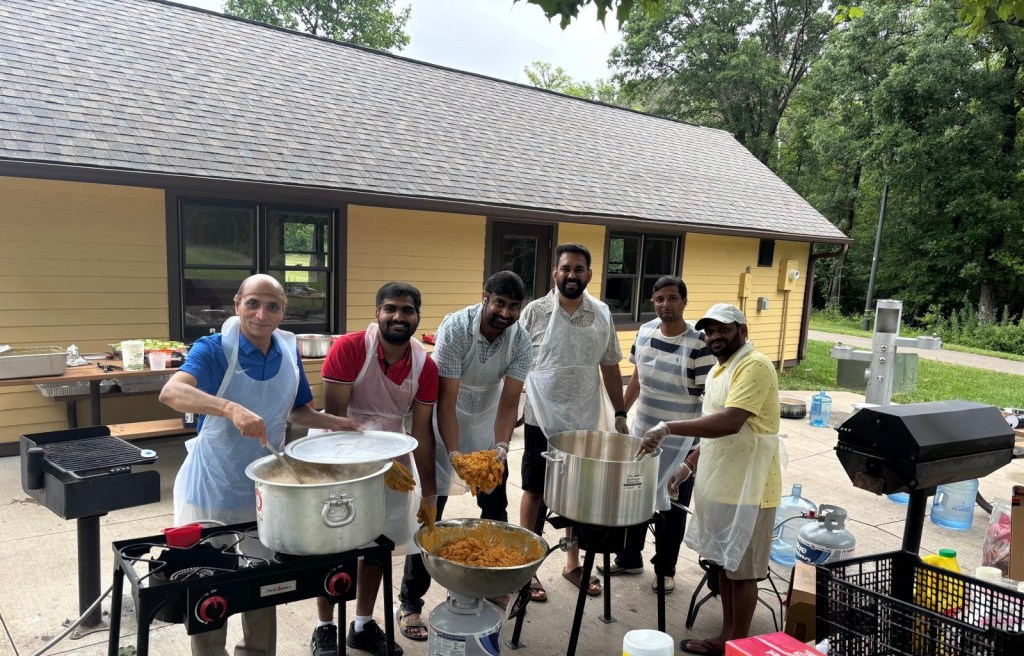
A clear goal of ‘SEWA’s Men’s Circle’ program is to engender an openness and willingness to learn and change. “What was allowable in previous generations in India is not allowable here. We encourage healthy gender norms for men, and encourage open conversations on the role of men in families. Our Men’s program now cooks in their monthly meetings, not because we are trying to change every aspect of the culture, but give a soft push on ideas that men can’t cook, or it’s not a man’s job, or it’s just women’s work”.
It was a proud moment for SEWA’s Men’s Circle team, who prepared and served a delicious food offering to over 200 attendees at SEWA’s All-Program picnic on July 25.
Raj Chaudhary – SEWA Founder
Raj Chaudhary, who founded SEWA-AIFW in 2004, established the organization in response to the urgent need to address domestic violence in the South Asian community. Reflecting on the organization’s earliest efforts, Raj said, “Domestic violence is an everyday thing. My connection with the community is more than programming. It’s creating citizenship, it’s creating families and communities together, and that is very fulfilling.”
Dipankar Mukherjee, Co-Founder and Artistic Director of Pangea World Theater, described the significance of Raj Chaudhary’s initiative: “SEWA provides a space where silencing is not an option anymore. There is a shared imagination, a vision, and a mission, that one day we will create a world and a space where women are safe.”
The SEWA Advocates
SEWA has a well staffed program, with many advocates supporting the survivors of domestic violence. Long time advocates with the program are Anjuli Cameron, Dasharath Yata and SriVani Gangi. Raj Chaudhary, SEWA’s retired founder also helps as needed. Each team member is a passionate proponent, and has their area of expertise. Based on the situation i.e. health concerns, domestic violence issues, the team determines who should respond.
Their mission is simple but powerful: ‘At SEWA-AIFW, we run a 24/7 confidential hotline and provide free/low-cost legal support, emotional support groups, shelter access, and medical referrals for South Asian and refugee survivors of domestic violence in Minnesota. Our approach is survivor-centered and culturally specific – we give information and options, so survivors can make their own empowered decisions. We’ve been doing this work since 2004 and partner across the Twin Cities to build a violence-free society by engaging the whole community’.
Dasharath Yata and SriVani Gangi provide further insight into SEWA-AIFW’s Gender Based Violence Program below.
Dasharath Yata
Though many cases are referrals from Domestic Violence agencies, cases also come through extensive community outreach. Almost every weekend, SEWA has organized Health clinics and annual Health Fairs, and SEWA’s program information, including domestic violence brochures are prominently displayed. These clinics are held at the Hindu and SV temples and Gurudwara on a rotating basis, and often religious/community leaders make referrals.
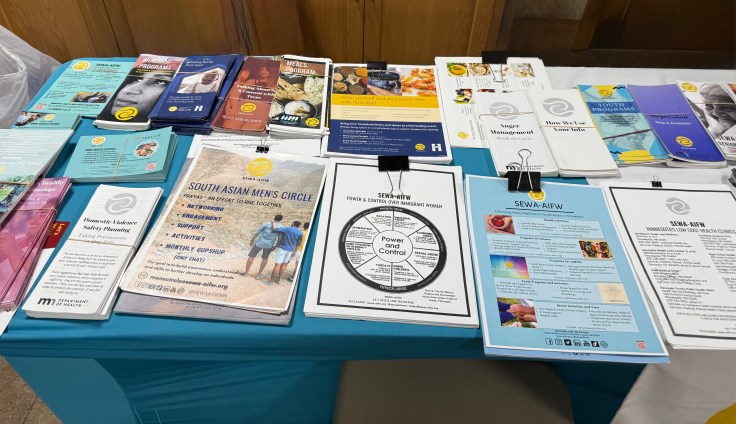
”I will go to the temple but I never sit in my seat. My job is outreach and talking to people about our services/resources and addressing their problems. We are mediators between the government and community, and we inform and provide resources to over 35 organizations that individuals don’t have access to”. Dasharath Yata
SEWA operates a 24/7 crisis line: 952-912-9100, and this information is printed on all SEWA’s material. Of the 400+ calls they get every year, approx 70% are related to domestic violence. Though the crisis line was set up for domestic violence, more recently SEWA’s scope has increased to taking calls related to senior abuse.
SEWA receives calls from the Indian, Pakistani, and other South Asian communities. Language difficulties and cultural expectations can make it especially difficult to recognize abuse, seek help, or understand legal rights. Collectively, SEWA’s staff speak approximately 13 languages, allowing SEWA to serve people from different backgrounds.
When someone reaches out, staff first assess the situation and develop a ‘Safety Plan’. Safety planning can include protecting passports, birth certificates, immigration/work documents; identifying safe places; and planning a response to escalating violence. Suicide can be a real risk, as callers are often on the verge of desperation. Legal services on a pro bono or low cost basis are available to those with limited financial resources.
Additional complications involve open communication, if the abuser is at home. Text and email can help if the survivor has access to those devices, and conversations continue only when the caller is able to speak safely.
SEWA’s role is much broader than simply responding to domestic violence incidents. It functions as a culturally specific bridge between survivors and the wider network of community and government resources, emphasizing safety, informed choices, empowerment, prevention and independence.
SriVani Gangi
Based on her daily interaction with domestic violence, handling 7-8 new calls/clients per month, in addition to existing cases, SriVani identifies several recurring patterns among South Asian immigrant families: Financial control and economic dependence; Threats of deportation as a tool of control; Arranged marriage dynamics and limited opportunity to know a partner before marriage; Language and cultural barriers; Pornography and sexual abuse creating conflict and abuse; Addiction; Pressure to remain married for the sake of children; Lack of family support with parents often encouraging daughters to stay in difficult marriages rather than return home.
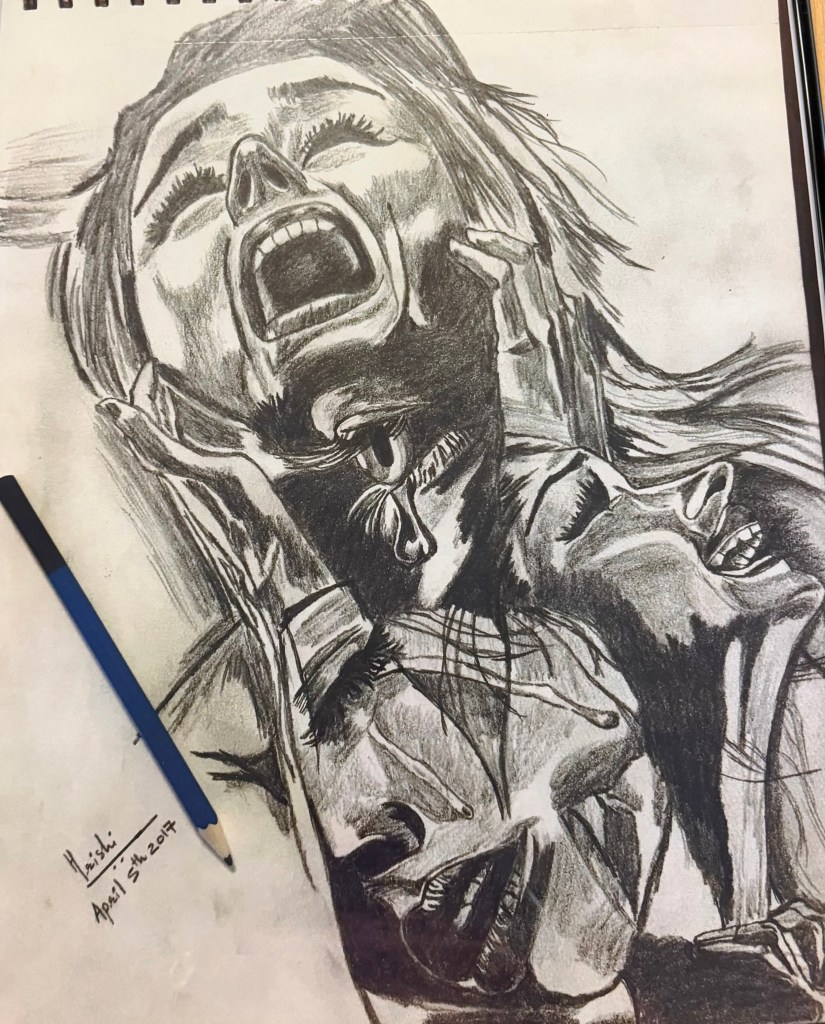
SriVani’s sustained advocacy work has shaped her ability to understand and aid survivors. She stresses that assistance is not necessarily about solving every problem, but providing support during an extremely difficult period.
She portrays domestic violence support as long term case management, than just responding to an emergency. It involves all the factors discussed above, while recognizing the substantial emotional and safety challenges faced by both clients and the SEWA staff.
Children are deeply affected and family issues can have significant consequences. These include school problems, behavioral issues, excessive gaming/electronic and substance abuse, emotional distress and conflict with parents.
A major challenge is that people experiencing abuse may begin to believe the threats and misinformation repeatedly communicated by their abusers. They need repeated reassurance and education.
In summary, SriVani says that domestic violence support requires more than formal training. Critical to helping survivors are strong listening skills, empathy and the ability to understand their perspective. “Sometimes they need someone to just believe them”!
A Helping Hand Forward
“Working in this space has a perception that we are only leading families down a path of divorce and separation. That is not true! There is a lot of work and support for a family that chooses to stay together. Ultimately all decisions are up to the survivor. We don’t push anyone in any direction. We just ask ‘where do you want to go and we will support you’. We have successful cases where people choose to stay with their spouses, and get enrolled in anger management and support groups”. Anjuli Cameron
SEWA’s ultimate goal is long-term empowerment, not just crisis response. They support survivors to build independence, and regain control over their lives.
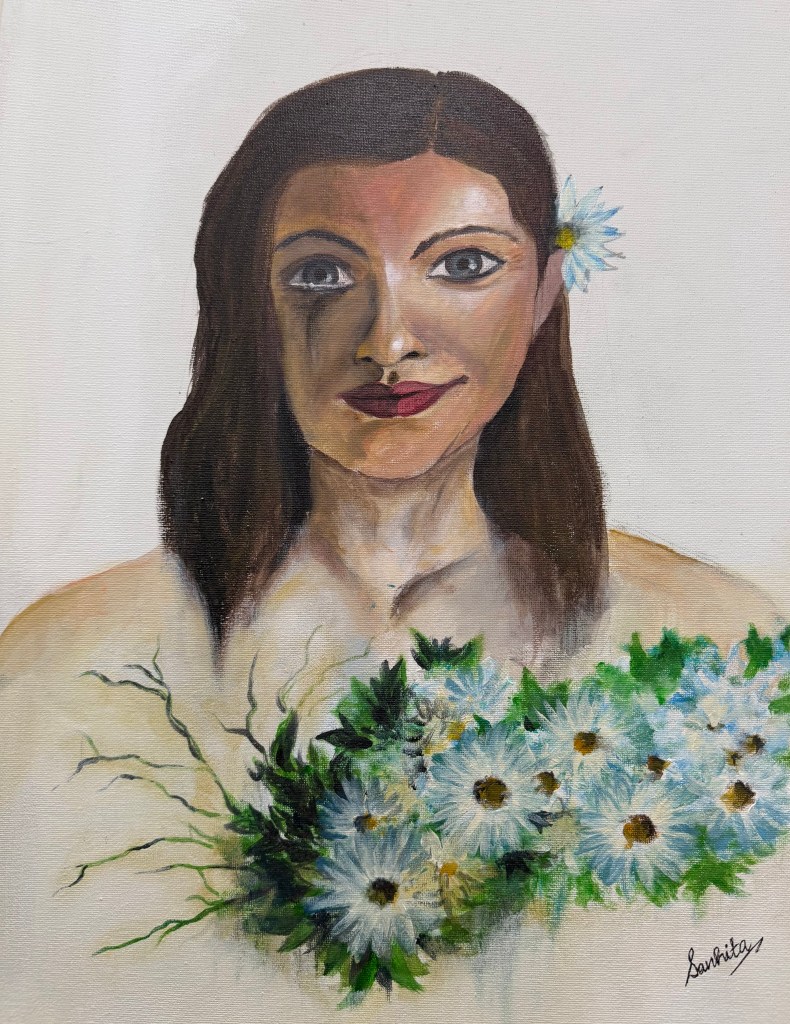
Discussion: Please send us your thoughts, by posting a comment at the end of the blog, and/or sending an email to ‘ruby@sewa-aifw.org’.
Our Mission
Sewa-Aifw is a nonprofit organization committed to serving, supporting, and enhancing family wellness for many communities, especially the vulnerable and underserved communities, in the Twin Cities and around Minnesota. We provide health care access, wellness information and resources, access to family violence resources and supports, and elder socialization activities
We envision a community that is healthy and violence-free, with self-determined women and engaged and supported elders and families

–


thank you ruby for sharing this beautiful story. this is a sensitive topic and people don’t usually talk about this openly in society. i hope your story will inspire everyone to speak up. special thanks to Raj Choudhary and Anjuli for organizing this and giving us a platform to share such important issues. i’m sure many people will benefit from this and it will give them the courage to not tolerate abuse.
LikeLike